




STIIMP | Implicit Induced Stimulation
Reinforce and Reward the use
of the pathological limb
Watch it in action. Watch the STIIMP presentation with patients
Upper limb impairment
A major challenge
Stroke, orthopedic trauma, or chronic pain frequently lead to partial or total upper limb impairment, severely affecting patients’ quality of life and daily activities such as eating, dressing, or simple hand movements.
Every year, 85 million people suffer from neurological disorders, leading to mobility deficits and loss of autonomy (WHO). Research confirms that rehabilitation intensity is a key factor in motor recovery—yet current care pathways often fail to deliver sufficient engagement.
Standard rehabilitation practice include different techniques:
- Visual Simulation Training (IVS technology)
- Passive mobilisation
- Task-oriented therapy
- CIMT (Constraint Induced Movement Therapy)
- Muscle strengthening
- FES (Functional Electrical Stimulation)
- Robot assisted therapy
“Motor learning is primarily ‘implicit’.
Patient must independently rediscover their abilities and the usefulness of their injured limb.”

Pr. Mickael DINOMAIS
PMR, Angers Hospital, France
STIIMP
Redefining rehabilitation
through Implicit Stimulation
STIIMP is based on neuroplasticity principles and motor learning, using smart, connected objects to encourage and reward the use of the affected limb—without mechanical constraints.
Rehabilitation objectives
STIIMP creates a highly engaging and interactive therapy experience, allowing patients to:
- Engage in cognitive and motor-based activities;
- Reduce compensation by the healthy limb;
- Receive real-time rewards and feedback for using the affected side;
- Work on memory, attention, and executive functions alongside motor recovery.
STIIMP: how it works
- Smart detection
STIIMP automatically recognizes the pathological hand and only provides feedback when the affected limb is used. - Adaptive training
Exercises dynamically adjust in difficulty based on the patient’s progress. - Diverse, playful exercises
Patients engage in a variety of cognitive and motor tasks (e.g., fine dexterity, reaction time, grip strength, bimanual coordination).
STIIMP enhances therapists’ expertise.
Therapists set the objectives, but patients discover their own strategies to achieve them.
The device adapts to each patient’s progress, but the therapist’s role remains central in monitoring, guiding, and optimizing rehabilitation strategies.
STIIMP is a tool to increase therapy intensity and engagement, but the human expertise of rehabilitation professionals remains irreplaceable in the process.
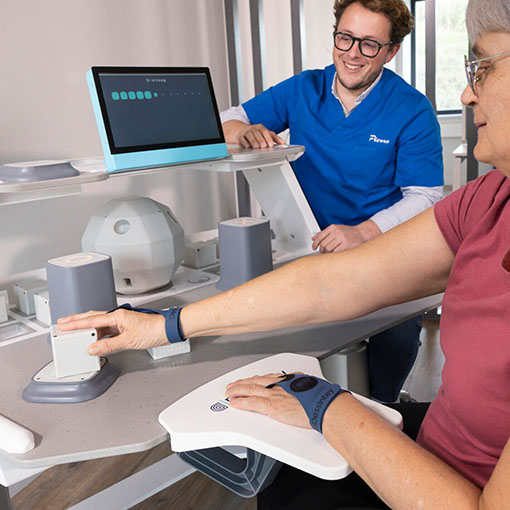
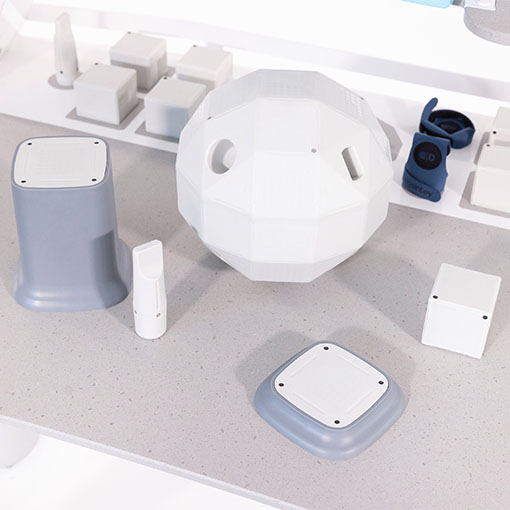
STIIMP | Redefining rehabilitation through implicit stimulation
STIIMP | Redefining rehabilitation through implicit stimulation
-
What is Induced Implicit Stimulation (STIIMP)?
STIIMP is mixing enriched environment, Implicit learning and principles of Constraint-Induced Movement Therapy (CIMT), but without imposing mechanical constraints. This concept allows patients to explore, learn, and progress naturally through both challenges and successes.
A new approach of CIMT
- Encourages movement without frustration
Unlike CIMT, which forces limb use through strict restriction of the healthy side, STIIMP fosters voluntary engagement thanks to implicit approach and create a positive emotional experience. - Broader patient inclusion
CIMT has strict inclusion criteria and is often impractical in daily practice. STIIMP is adaptable to various impairments and patient abilities. - Bilateral engagement
While CIMT focuses only on unilateral movements, STIIMP enables both uni- and bi-manual activities, making therapy more functional and natural.
- Encourages movement without frustration