




IVS | Intensive Visual Simulation
A unique technology dedicated
to motor planning & central control of movement
Discover Dessintey in video
Motor control principles
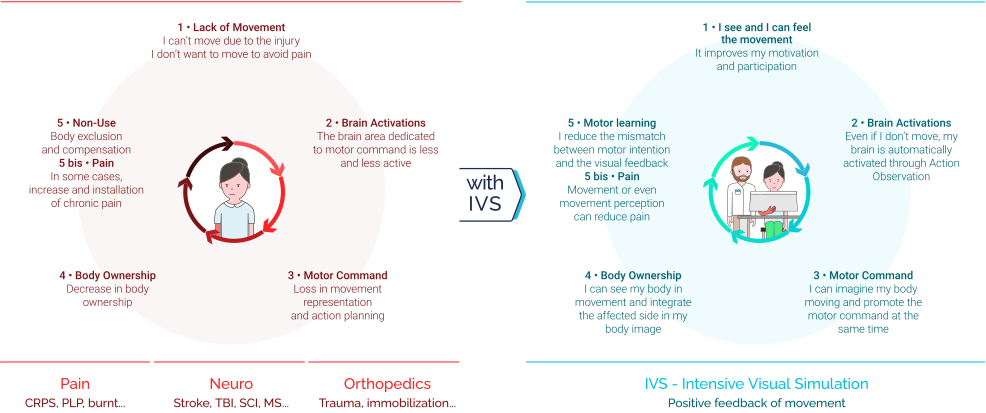
Action planning is quickly altered in patients
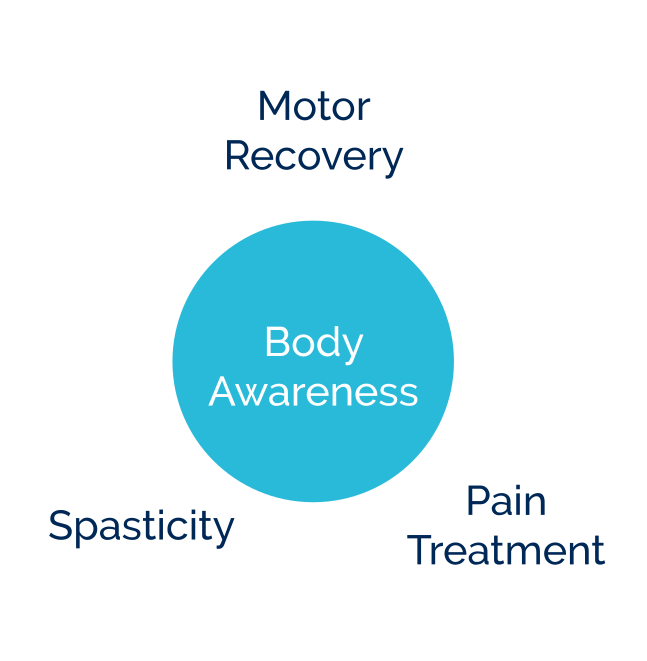
For many Stroke or CRPS patients, Action planning is altered or non‑existent. They lose awareness of their own body, but also the memory of motor functions.
Without representation of movement, i.e. without this essential stage of action planning, the movement cannot be effective and accurate.

“The problem is not the repetition of movement but the ability to plan what to do.
It’s not a problem of muscle power, it’s a problem of control of the body.”

Dr. Franco MOLTENI
Clinical Director – Villa Beretta
Rehabilitation Center, Italy
IVS3 for Upper Limbs
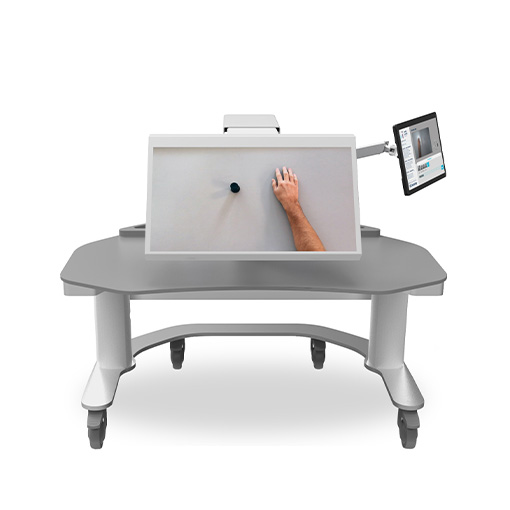
Vision plays an essential role in the early stages of reconstructing body image and motor control. With an intense immersion, IVS allows the patient to reintegrate a healthy functional limb and to focus on the representation of movement.
IVS4 for Lower Limbs
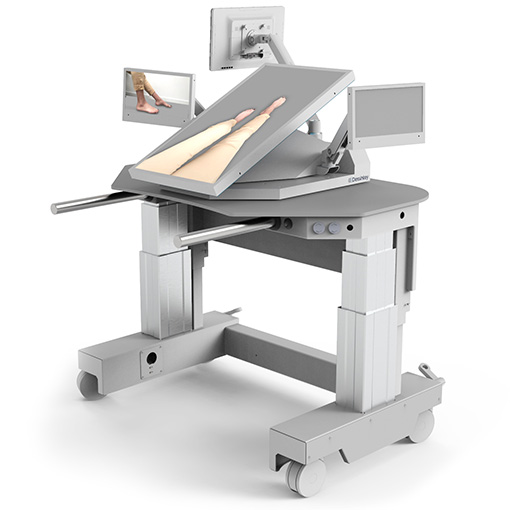
Adapted to wheelchairs, the IVS4 allows patients to work seated to learn basic movements and more complex coordination, then in a standing position, to focus on a functional approach to balance and walking.
“Seeing a movement is almost like doing it.”
IVS replaces the image of the affected limb with a positive image of movement performed by the healthy limb.
Upper or Lower Limb movement observation with IVS automatically induces a cortical sensorimotor activation.
Reinstating coherence between what the patient intends to do and the sensations he perceives prompts relearning.
IVS – Intensive Visual Simulation
Positive visual feedback promotes relearning
IVS relies on brain plasticity principles.
Integrating IVS among the therapeutic pathway stimulates the central control of movement and bolster patients’ abilities in action planning.
The technological platform
Personalized therapy programs
Showcasing more than 15 years of research, IVS integrates a smart therapy-based algorithm assistance to make the therapists’ day-to-day work easier.
Based on the evaluation performed by the therapist, IVS offers a variety of exercise sequences.
It recognizes the best suited movements to the patient’s impairments.
IVS manages the planning of sessions and patient’s overall program.
Why is IVS
a unique & patented technology?
a unique & patented technology?
- Intense immersion to reintegrate a healthy functional limb
- High level of clinical evidence on VST approaches (both for Upper & Lower Limbs)
- Neurological lateralized stimulation
- Early start of therapy, accessible to flaccid patients or cognitive disorders
- “Enhanced assistant” with diversified exercises
- Intensive therapy with few exclusion criteria
- Ultra-easy to handle: 30 sec. to start a session
- Complementary to conventional approach and robotic devices
A patient-centric solution
developed with clinicians
developed with clinicians
Autonomy

Evaluations
Free session
Guided session

Movement library
Presentation

Progress & activity reports
New
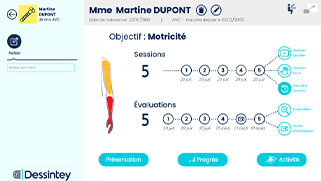
Autonomous work: the therapist can authorize the patient to work independently using the IVS technology (activation, pre-programming of sessions, and monitoring).
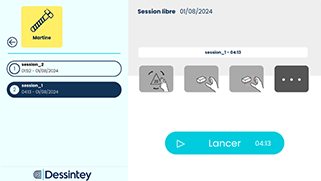
More inclusive software ergonomics and simplified navigation:
- Access to an exercise library without going through the assessment;
- Recording a video to track progress.
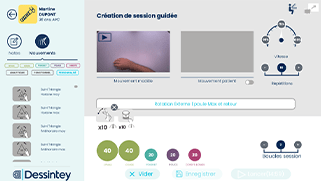
New features:
- Videos directly usable by the patient;
- Translation into more than 10 languages;
- Usage data easily recoverable.
IVS technology combines approaches with high level of clinical evidence on motor recovery and pain treatment
IVS technology combines approaches with high level of clinical evidence on motor recovery and pain treatment
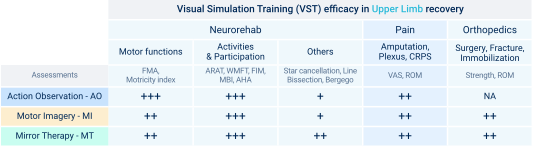
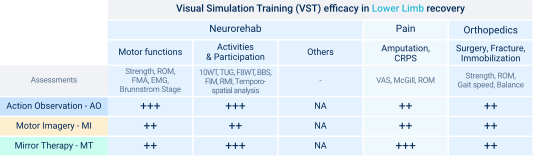
+ + + : efficacy proven in various RCT | + + : efficacy proven in review and meta‑analysis (moderate effect) | + : efficacy proven in review and meta‑analysis (low effect)
Complementarity
IVS is used in addition to other conventional therapies & technologies
Complementarity
IVS is used in addition to other conventional therapies & technologies
IVS3 for Upper Limbs
- FES
- Muscle strengthening
- Task-oriented therapy
- CIMT
- Robot-assisted therapy
IVS3 for Upper Limbs
- Active and passive mobilization
- FES
- Trunk reinforcement & balance therapy
- Isokinetism
- Robot assisted therapy – Exoskeleton
IVS | Indications
IVS | Indications
Clinical Indications
- Stroke
- Brain injury
- Multiple sclerosis
- CRPS
- Amputation
- Cerebral palsy
- SCI
- Immobilization
- Plexus injury
- Trauma
Large inclusion criteria
- Flaccid limbs
- Spasticity
- Hemineglect
- Apraxia
- Body image disorders
- Bimanual impairments
- Aphasia
- Cognitive disorders
- Attention deficits
- Learning disabilities
- Pain
- Allodynia…
An intensive upper limb therapy
Early intervention in the rehabilitation process, accessible to frail patients
The ARM LAB is an environment composed of various rehabilitation tools, designed to promote the recovery and strengthening of complex arm and hand skills.
This concept is based on three fundamental pillars:
- Early and intensive care
- Varied and complementary therapies and stimulations
- The engagement and motivation of the patient